
Search
Edge filters
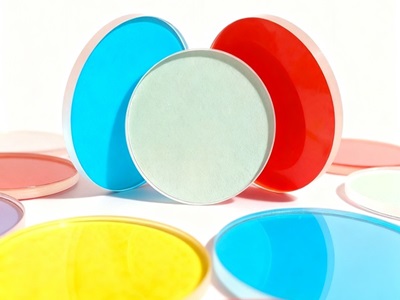
Edge filters block the light in a defined spectral region while transmites in a closely adjacent region . If the transmission region lies in the longer wave region compared with the rejection region, the filters are called long pass filters or cut on filters. In the inverse case, the filters are short pass filters or cut off filters.
Products
Related products
Traditional longpass filter
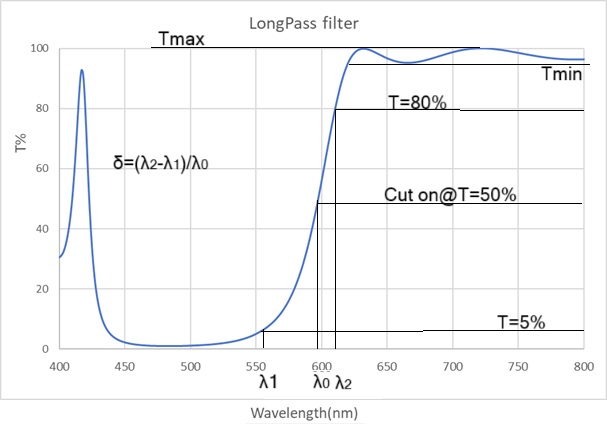
Tmax is the maximum transmittance in the transmitted area, Tmin is the minimum transmittance in the transmitted area.
Tave is the average transmittance in the transmitted area, Tave=(Tmax+Tmin)/2.
Cut-On is defined as the position of the transmittance T=50%.
Slope δ: expresses the relative width of the wavelength interval between the passband region and the blocking region relative to the wavelength position of the filter. The smaller this value, the steeper the filter's transmission curve. δ=(λ2-λ1)/λ0*100.
Traditional shortpass filter
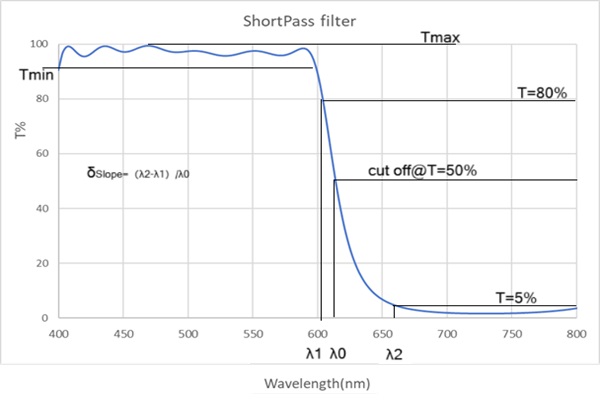
Tmax is the maximum transmittance in the transmitted area, Tmin is the minimum transmittance in the transmitted area.
Tave is the average transmittance in the transmitted area, Tave=(Tmax+Tmin)/2.
Cut-off is defined as the position of the transmittance T=50%.
Slopt δ: expresses the relative width of the wavelength interval between the passband region and the blocking region relative to the wavelength position of the filter. The smaller this value, the steeper the filter's transmission curve. δ=(λ2-λ1)/λ0*100.
Steep edge filter
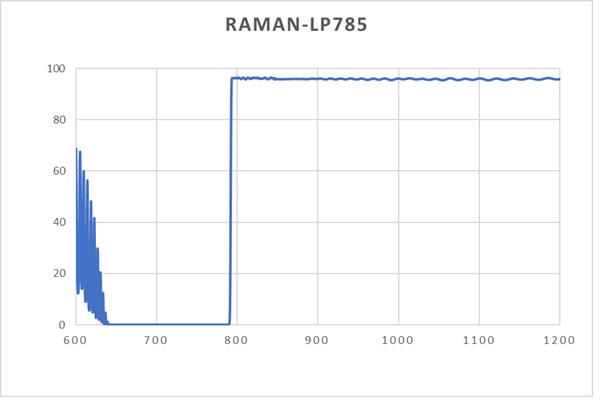
Steep edge filters can be classified into steep longpass filters and steep shortpass filters based on their spectral type. Compared with traditional edge filters, steep edge filters have a steeper transition between the transmission band and the blocking band, usually only a few nanometers. They are mainly used in fluorescence microscopy and similar applications.