
Search
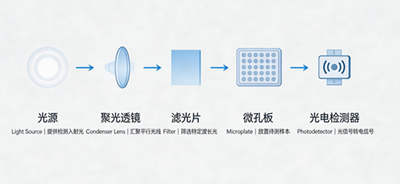
Principle of Microplate Reader Detection and Selection of optical filter
Products
- Principle of Microplate Reader Detection
- 1. The microplate reader follows the Lambert-Beer law and achieves quantitative measurement by measuring the absorbance (Abs) of the sample. The absorbance is proportional to the sample concentration and can be converted to concentration through a standard curve.
- 2. Detection Procedure (Absorbance Mode).
- a. Light source: Xenon lamp/tungsten lamp emits composite light.
- b. Monochromator: A filter or grating acts as a monochromator to change the composite light emitted by the light source into monochromatic light (e.g., 450 nm commonly used in ELISA).
- c. Sample Absorption: Monochromatic light passes vertically through the microplate sample, and part of it is absorbed by the enzyme-catalyzed colored product.
- d. Signal conversion: Photodiodes (PD) / photomultiplier tubes (PMT) convert transmitted light into electrical signals, which are then amplified, logarithmically converted, and A/D sampled.
- e. Calculate output: The microprocessor calculates the absorbance value (Abs) and provides the sample concentration by comparing it with the standard curve.
- 3. Extended detection modes: a. Fluorescence mode. b. Time-resolved fluorescence (TRF) mode. c. Chemiluminescence mode. d. Fluorescence polarization (FP) mode.
- Optical path structure of Microplate reader
- 1. Filter-based optical path (traditional economical type).
- Structure: Light source → filter wheel (multiple fixed-wavelength filters) → sample → detector.
- Features: simple structure, low cost, fast speed, and low stray light. Fixed wavelength (e.g., 405/450/492/630 nm). Suitable for fixed-wavelength ELISA and routine colorimetric detection.
- Typical configuration: 8-10 filter positions, standard 405/450/492/630nm, other wavelengths can be customized.
- Other configurations and detection scenarios: Nucleic acid quantification detection is configured at 340nm, etc. Protein quantification detection is configured at 405nm, etc.
- 2. Filter-based optical path (absorbance/fluorescence dual mode) - The absorbance mode is as described above, and the fluorescence optical path is designed as follows:
- a. Vertical excitation – vertical detection optical path (bottom read / top read, most commonly used).
- b. 90° orthogonal optical path (side excitation / side detection).
- c. Focused optical path (high-end fluorescence / chemiluminescence general purpose)
- Filter types: a. Excitation Filter b. Dichroic Mirror c. Emission Filter
- Typical configuration: FITC/Fluorescein: Ex 485nm/Em 535nm FAM: Ex 495nm/Em 520nm Cy3: Ex 550nm/Em 570nm Cy5: Ex 640nm/Em 670nm.
- 3. Grating Optical Path (Full Wavelength / Multifunctional)
- Structure: Light source → Grating monochromator (diffraction grating dispersing) → Sample → Detector.
- Features: Continuous wavelength (200-1000nm), can achieve 1nm steps, capable of full wavelength scanning. Wavelength is arbitrarily adjustable, suitable for nucleic acid/protein quantification, spectral scanning, etc. Adjustable bandwidth (5-30nm) to improve detection accuracy.
- Selection and Procurement of Microplate Reader Filters
- Key Points for Model Selection and Procurement a. Matching the Model: First, confirm the size of the filter wheel and choose filters suitable for the corresponding brand model.
- b. Wavelength selection: Absorbance: ELISA requires 405, 450, 492, 630 nm; Enzyme kinetics add 340 nm.
- c. Fluorescence: FITC (485/535), Cy3 (550/570), Cy5 (640/670).
- d. Maxoptics.cn can provide filters with wavelengths outside the standard range, such as 415 nm, 420 nm, 460 nm, 490 nm, 540 nm, 562 nm, 570 nm, 595 nm, 600 nm, 650 nm, etc.
- e. The sizes can be customized, including Dia10mm, Dia12mm, Dia12.7mm, Dia15mm, etc.