Search

Optical Filter and Laser Ranging
Products
- Principle of Laser Rangefinding
- 1. Pulsed laser ranging: The laser emits extremely narrow light pulses to the target → the reflected light returns, and a timer measures the time of flight (TOF). Formula: Distance = 2c × t, where c is the speed of light and t is the round-trip time. Features: long-range measurement: from a few meters to several kilometers or tens of kilometers, fast speed. Suitable for: rangefinders, surveying, security, drones, and autonomous driving.
- 2. Phase-based laser ranging: emits modulated continuous light and measures the phase difference between emission and reception. It has high accuracy but is for short distances (tens to a few hundred meters) and is mostly used in: total stations, precision ranging.
- 3. Flight Time Camera TOF: Area array imaging, simultaneously measuring the distance of the entire image. Mostly used for: obstacle avoidance, 3D perception.
- Typical optical path design and filters
- Emission optical path: pulsed laser → collimating lens → emitted light → target; Laser: 905nm / 1064nm / 1550nm; Lens: compresses the light into a narrow beam to increase range; Receiving optical path (core): target reflected light → receiving lens → filter → photodetector (APD).
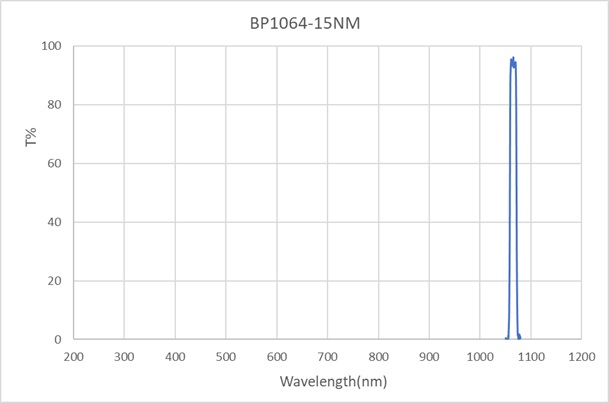
- The main type of optical filter used in laser ranging is a narrow bandpass filter NBPF (or bandpass BPF). Its function is to only allow the laser wavelength to pass through, blocking sunlight, lamp light, and stray light, thereby improving the signal-to-noise ratio → measuring farther, more stably, and resisting strong light; common filter wavelength bands are 905 nm, 1064 nm, and 1550 nm.
- Core Technical Parameters of the Optical Filter:
- 1. Central wavelength CWL: 905nm, 1064nm, 1550nm.
- 2. Bandwidth FWHM: standard ranging: 10~20nm, long distance / strong light resistance: 5~10nm.
- 3. Transmittance Tmax and Blocking OD.
- Maxoptics.cn uses ion beam assisted deposition technology and ion beam sputtering deposition technology to research and produce optical filters for laser ranging. The core wavelengths are 905nm, 1064nm, and 1550nm; the transmittance is greater than 90%, and the bandwidth can be adjusted from 5nm to 30nm according to customer requirements; the film structure is dense, and the center wavelength is confirmed to have no drift during operation, making it capable of withstanding harsh working environments.
-