Search
Principle of QPCR Fluorescence Detection and Filter Selection
Products
- Principle of qPCR Fluorescence Detection
- qPCR (quantitative polymerase chain reaction) is based on the principle of adding fluorescent probes or dyes during the PCR reaction to dynamically monitor changes in fluorescence signals during the nucleic acid amplification process, thereby enabling quantitative analysis of the initial template. This process requires the use of optical filter to aid in the collection of fluorescence signals. Ordinary PCR only performs amplification without real-time detection and does not require the use of optical filter.
- qPCR optical path design
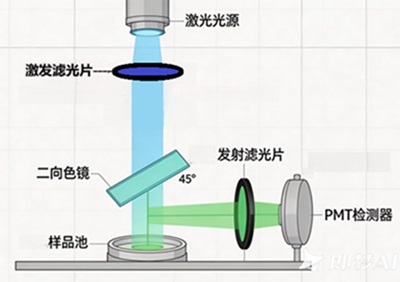
- Typical optical path configuration: light source (laser/LED/halogen lamp) → excitation filter → sample → dichroic mirror → emission filter → detector (PMT/PD).
- 1. Side-illumination optical path (lateral excitation / lateral detection).
- 2. Confocal Optical Path (Confocal).
- 3. Filter Wheel Optical Path.
- 4. Multi-channel parallel optical paths (multiple sets of filters, multiple detectors).
- 5. Fiber-coupled optical path.
- The Core Role and Types of optical filter in the qPCR Optical Path
- Because the fluorescence signal is very weak, stray light from the sample cell, tube wall fluorescence, reagent autofluorescence, and ambient light interference can seriously interfere with the collection of fluorescence signals. Therefore, it is necessary to use optical filter for filtration. Filters are key components that determine the sensitivity of qPCR instruments; they can greatly improve the signal-to-noise ratio (SNR), allowing the instrument to detect weak fluorescence signals, thereby significantly enhancing detection sensitivity.
- 1. Excitation filter: Only allows light signals of specific excitation wavelengths to pass through.
- 2. Dichroic mirror: reflects excitation light, transmits fluorescence, usually used at a 45° angle.
- 3. Emission filter: only transmits the target fluorescence signal, blocking the excitation light and stray light in the optical path.
- 4. Multi-channel filters (MBP): A multi-channel parallel optical path design can use multiple sets of single-channel filter groups arranged in parallel, or directly select multi-channel filters, making the instrument structure more compact.
- Key Parameters of Common Fluorescence Channels and Filters in qPCR
- The excitation filter spectrum type is usually a band-pass filter, and the emission filter spectrum type can be a band-pass filter or a high-steepness long-pass cutoff filter. The dichroic mirror is an interference cutoff filter designed for 45°, and the spectrum types include long-pass filter and short-pass filter.
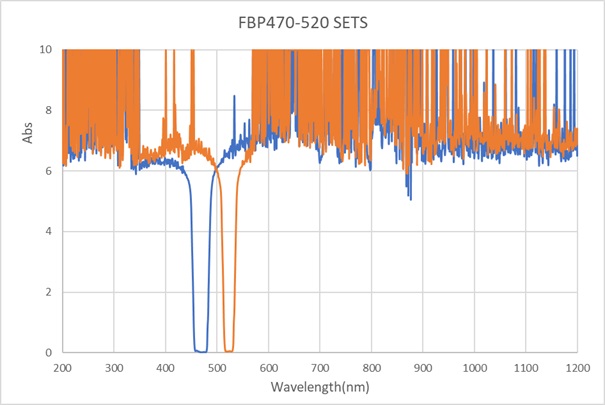
- Different fluorescence detection channels correspond to different fluorescent dyes or fluorescent probes, with each channel corresponding to a set of excitation and emission filters. For example, FAM / SYBR Green excitation: 470 nm, emission: 520 nm; VIC / HEX / JOE excitation: 530 nm, emission: 570 nm; ROX excitation: 580 nm, emission: 610 nm; Cy5 / Texas Red excitation: 620 nm, emission: 680 nm.
- Key indicators of fluorescent detection bandpass filters: center wavelength (CWL), full width at half maximum (FWHM), blocking depth, blocking range, steepness, etc. These spectral indicators directly affect the sensitivity of fluorescent signal detection. Maxoptics.cn can customize various types of spectral fluorescent detection filters according to customer requirements.
-