Search
Principle of NDIR Non-Dispersive Infrared Gas Analysis and Selection of optical filter
Products
- NDIR Non-Dispersive Infrared Gas Analysis Detection Principle
- 1. Most inorganic/organic gases have corresponding characteristic absorption peaks in the mid-to-far infrared region (2–14 μm). Specific gases only absorb infrared light of specific wavelengths and do not absorb other wavelengths; this is the premise of NDIR infrared gas detection.
- 2. Absorption follows the Lambert-Beer law: A = lg(I₀/I), the attenuation of infrared light intensity is proportional to concentration, and the gas concentration can be calculated by measuring the light intensity attenuation at characteristic wavelengths.
- 3.Non-dispersive infrared gas detection equipment optical path structure: infrared light source, collimating lens, gas chamber (gas absorption cell), filter wheel/double filter (measurement and reference), infrared detector (thermopile, pyroelectric), signal processing circuit.
- Infrared Gas Analyzer Optical Path Structure
- 1. Single-beam dual-wavelength optical path.
- 2. Dual-beam single-wavelength optical path (dual optical paths in parallel).
- 3. Reflective (folded) optical path (long optical path, low concentration detection) design.
- Filter Technical Parameters and Type Configuration
- 1. Gold film: The gold film can achieve high reflectivity for infrared detection signals.
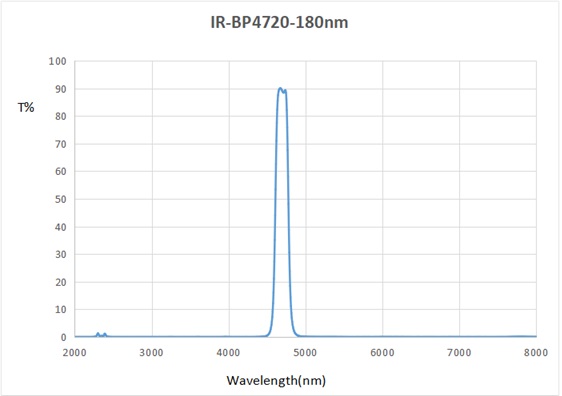
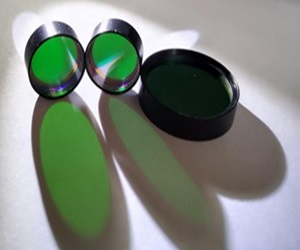
- 2. Infrared bandpass filter: Center wavelength CWL: corresponds to the characteristic absorption peak of the gas, half bandwidth FWHM: 40-300 nm, transmittance: >80%, cutoff depth: OD2~OD3.
- 3. Infrared window (AR anti-reflection coating): Transmits infrared light signals while protecting the chamber from leakage and contamination.
- Application scenarios of characteristic gas detection with infrared filters
- 1. Industrial Safety and Explosion-Proof Applications: Coal mine gas monitoring, petrochemical combustible gas detection, pipeline leak monitoring.
- 2. Environmental Monitoring and Flue Gas Analysis Applications: air quality monitoring, greenhouse gas monitoring, online environmental analysis.
- 3. Chemical and special gas monitoring applications: monitoring toxic and harmful gases in farms, sewage treatment plants, refrigeration rooms, and chemical workshops.
- 4. Vehicle and traffic exhaust emission testing.
- How to choose an infrared filter suitable for a specific application scenario?
- 1. Select the measurement (absorption) wavelength according to the type of gas to be tested. Usually, the strongest characteristic absorption peak of the gas is selected as the center wavelength of the filter, for example, CO₂: 4.26 μm, CO: 4.67 μm, CH₄: 3.3 μm. A wavelength where the gas does not absorb is chosen as a reference wavelength to compensate for drift.
- 2. Select the half-bandwidth based on the concentration range of the gas to be measured. For gases at low concentrations and requiring high precision, narrow bandwidth (around 100 nm) infrared filters can be chosen, which have strong anti-interference capability. For gases at high concentrations, a wider bandwidth (200–300 nm) can be selected, which provides strong signals and low cost.
- 3. Select the cut-off depth (OD value) according to the working environment. For complex ambient light with many interferences: choose a background depth of OD3 or above to suppress stray light. For ordinary indoor/industrial environments, a background depth of OD2 is sufficient.
- 4. Select substrate materials based on the wavelength range. 2–5 μm: Si (silicon), 3–5 μm: sapphire, 2–14 μm: Ge (germanium), ZnSe.
- 5. Choose the size specifications based on the brand and instrument structure.
- 6. When measuring stability, it is required to choose a transmittance that is as high as possible.
-