Search
Filter Spectral Types and Technical Specifications
Products
- Technical Specifications of Interference Edge Filter
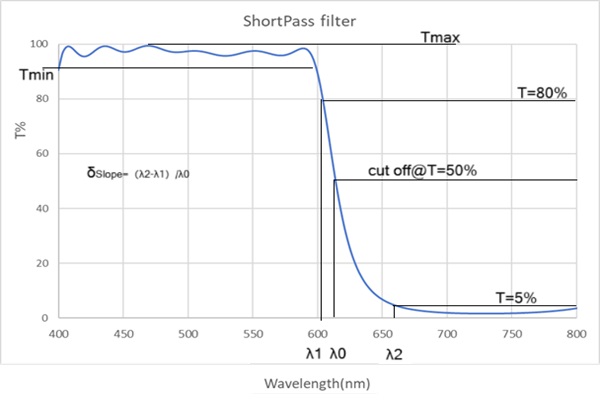
- Cut-on/off wavelength definition: the wavelength at which the transmittance drops to 50% of the peak transmittance, which is the critical value distinguishing the passband from the stopband.
- Definition of blocking depth (Blocking/Optical Density, OD): the light blocking capability within the stopband, OD = lg(1/T) (T is the transmittance).
- Peak transmittance / average transmittance: the maximum transmittance within the passband / the average transmittance within the passband.
- Transition Band / Slope: Describes the steepness of the cutoff edge.
-
- Edge filter type
- 1. LongPass: Simply understood, it means that when the wavelength >cut-on wavelength, it transmits; when the wavelength<cut-on wavelength, it is blocked.
- 2. Shortwave Pass (ShortPass): Simply put, it blocks when the wavelength > cut-off wavelength and transmits well when the wavelength < cut-off wavelength.
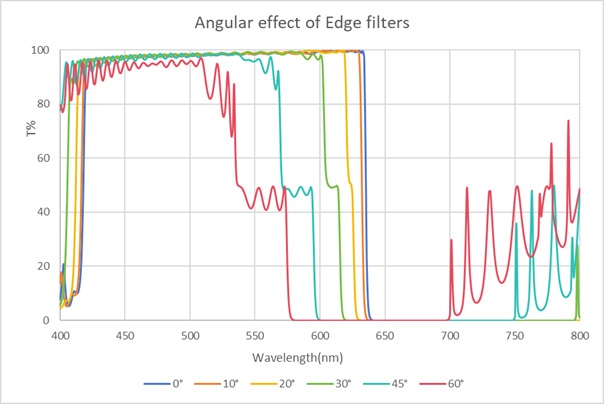
- The influence of the angle of incidence (oblique incidence, conical incidence)
- 1. Overall spectrum blue shift (moving toward shorter wavelengths).
- 2. The shape of the spectral curve deteriorates, and the cutoff band shrinks and narrows.
- 3. The separation of s- and p-polarized light increases with the increase of the incident angle, causing the transition band to exhibit steps or for the transition band to become gentler.
- 4. Cone angle incidence effect: Because the most common lens focusing, optical fiber emission, and imaging light paths are not parallel light but cone light with angular distribution, the equivalent "average angle" causes a blue shift, and similarly, there will be a smoothing of the transition band, among other effects.
-
- Bandpass filter technical specifications
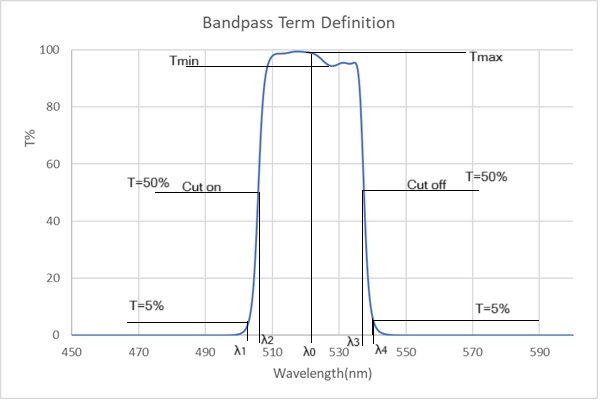
- Center Wavelength (CWL): The wavelength corresponding to the center position of the passband.
- Full width at Half Maximum (FWHM): the wavelength width at 50% of the peak transmittance
- Peak transmittance / average transmittance: the maximum transmittance / average transmittance within the passband.
- Transition Band/Slope: Describes the steepness of the edges on both sides of the passband.
-
- Bandpass filter type
- 1. Broadband WBP: Full width height max transmittance is relatively wide compared to the central wavelength.
- 2. Band-pass (BP) and narrow band-pass (NBPF): the full width at half maximum is relatively narrow compared to the central wavelength.
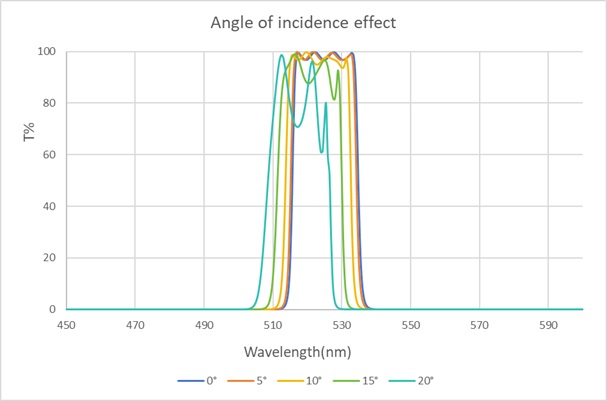
- The influence of the angle of incidence (oblique incidence, conical incidence)
- 1. Overall spectrum blue shift (moving toward shorter wavelengths).
- 2. The shape of the spectral curve deteriorates, and the cutoff band shrinks and narrows.
- 3. The separation of s- and p-polarized light increases with the increase of the incident angle, causing the transition band to exhibit steps or for the transition band to become gentler.
- 4. Cone angle incidence effect: Because the most common lens focusing, optical fiber emission, and imaging light paths are not parallel light but cone light with angular distribution, the equivalent "average angle" causes a blue shift, and similarly, there will be a smoothing of the transition band, among other effects.
-