Search
Detection of Swine Fever and Core Parameters of Optical Filter
Products
- Principle of Optical Detection for Swine Fever
- 1. Real-time fluorescent quantitative PCR : Primers and fluorescent probes (such as FAM, HEX, CY5) are designed for the conserved genes of classical swine fever virus (CSFV/ASFV); during PCR amplification, the probe is hydrolyzed, thereby releasing fluorescence, and the fluorescence intensity is monitored in real-time by a QPCR instrument to determine whether it is positive.
- 2.Fluorescent Antibody Test (FAT/IFA): Uses fluorescent-labeled antibodies to bind with viral antigens in the sample; specific fluorescence is generated upon exposure to excitation light, and the results are determined as positive or negative through a microscope/analyzer.
- 3.Colloidal gold immunochromatography (rapid test): The gold-labeled antibody binds with the sample antigen, forming a visible band on the test line; the gold-labeled reader quantifies it through the intensity of reflected/absorbed light.
- Swine Fever Fluorescence Detection Optical Path Structure
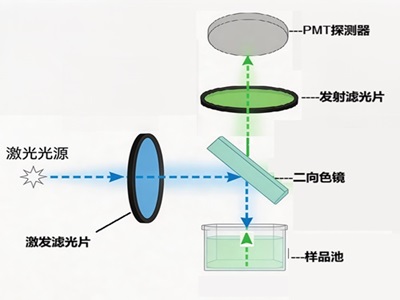
- 1.The light source LED/Xenon lamp emits broadband light → the excitation filter filters out a specific wavelength (e.g., 470 nm). The dichroic mirror reflects the excitation light to the sample and transmits the fluorescence emitted from the sample (e.g., 520 nm). The emission filter removes stray light → PMT/CCD/PD collects the fluorescence signal.
- 2.Structure of the colloidal gold immunochromatography optical path: The excitation and detection optical paths are set at a certain angle (e.g., 45°) to reduce direct light interference. Typically, an LED light source → collimating lens → illumination of the test strip T/C lines → reflected light filtered through a narrow-band filter → detector PD/CCD.
- 3. Types of Optical Filters: a. Excitation Filter b. Dichroic Mirror c. Emission Filter.
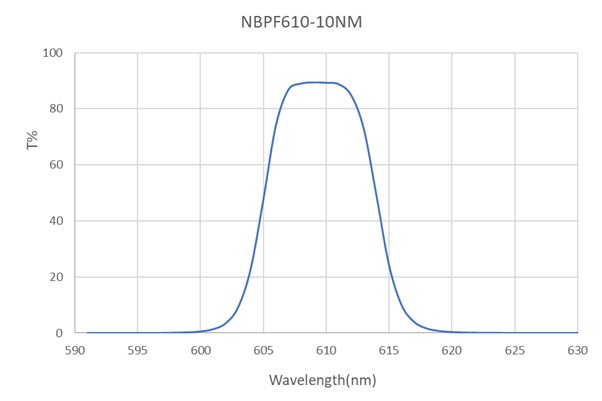
- 4.Reference for general technical specifications of excitation and emission filters: Center Wavelength (CWL): ±2 nm. Full Width at Half Maximum (FWHM): 10~30 nm for fluorescence signal detection; 10–20 nm for colloidal gold. Transmittance (T): Peak ≥ 80%–90% (passband). Optical Density (OD): OD4–OD6 (determines signal-to-noise ratio).
-