Search
Principle of water quality monitoring instrument and Core parameters of optical filter
Products
- Optical Principles of Water Quality Monitoring Instrument
- 1. Spectrophotometry (COD, ammonia nitrogen, total phosphorus, heavy metals, etc.): Core principle: Based on the Lambert-Beer law, that is, the substance to be measured has characteristic absorption peaks at specific wavelengths, and the absorbance is proportional to the concentration.
- 2. Turbidity/Suspended Solids Detection (Scattering Method). Principle: Light illuminating suspended particles produces 90° scattering, and the intensity of the scattered light is positively correlated with turbidity (NTU).
- 3. Ultraviolet Absorption Method (UV254, Rapid Measurement of COD/TOC). It directly measures the transmittance of 254 nm ultraviolet light, corresponding to the concentration of organic matter, requiring no reagents and enabling rapid online testing.
- Spectrophotometric Optical Path Structure of Water Quality Monitor
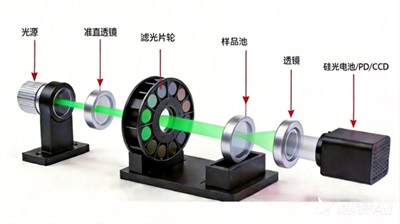
- 1. Single-beam vertical transmission type (portable / benchtop): light source (tungsten lamp/deuterium lamp/LED) → collimating lens (parallel light) → filter wheel/fixed filter (wavelength selection) → cuvette/detection cell (water sample) → condenser lens → photoelectric detector (silicon photodiode/PD/CCD) → signal amplification → absorbance/concentration calculation.
- 2. Dual optical path: includes a measurement/reference optical path. One path measures the sample, while the other measures the blank as a reference, allowing real-time correction of light source drift, temperature, and stray light interference.
- Selection of Optical Filters for Water Quality Monitoring Instruments and Core Technical Parameters
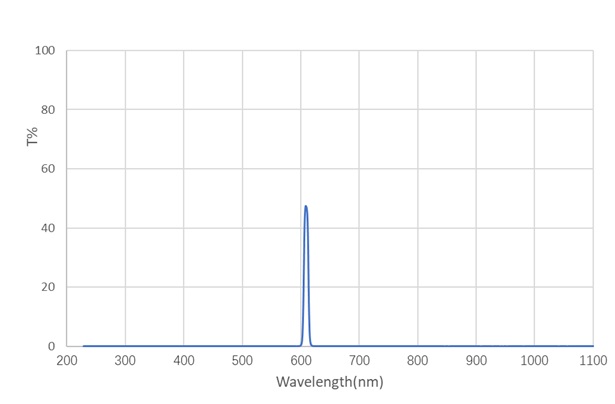
- 1. Central wavelength: 420 nm, 470 nm, 520 nm, 540 nm, 620 nm, 690 nm. Ultraviolet: 254 nm (COD/UV).
- 2. Full Width at Half Maximum (FWHM): 8 nm ~ 12 nm Function: Ensure monochromaticity, avoid stray light interference with absorbance
- 3. Peak Transmittance Tmax (Visible Spectrum): ≥50%
- 4. Blocking: OD4 ~ OD6, light outside the passband is suppressed by 10⁴~10⁶ times.
- Sizes can be customized, including φ10mm, φ12mm, φ12.7mm, φ15mm, etc.
-