
Search
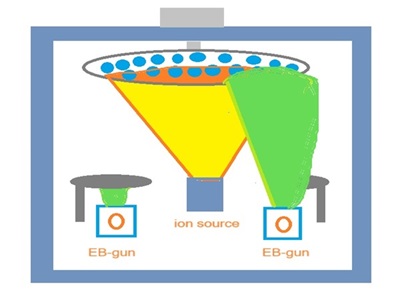
Principle of Ion-Assisted Deposition Technology
Products
- Principle of Ion-Assisted Deposition Technology
- Ion-Assisted Deposition (IAD) is a process in vacuum vapor deposition where high-energy ion beams are introduced to simultaneously bombard the surface of the growing film. By transferring energy from the high-energy ions, it regulates the microstructure and composition of the film. The core advantage lies in significantly improving the film's density, adhesion, and optical and mechanical properties through precise independent control of the film deposition parameters and ion-assisted parameters.
- Function of Ion-Assisted Deposition Technology
- 1. Energy activation and film structure densification: High-energy ions (typically 50–500 eV) bombard the growing surface, increasing the surface mobility of film atoms, inhibiting columnar crystal growth, making the film density approach the theoretical value, and eliminating the loose defects of conventional thermal evaporation.
- 2. Interface reinforcement and adhesion improvement: Ion bombardment generates localized thermal effects and achieves atomic-level mixing in the film, forming a transition layer at the interface between the substrate and the film, significantly enhancing the bonding strength (up to more than 10 times that of conventional processes).
- 3. Stoichiometric ratio control: Introducing reactive gases (such as O₂, N₂) as auxiliaries allows ions to promote efficient reactions between gas-phase atoms and the reactive gases, precisely controlling the composition ratio of compound films (such as oxides and nitrides). For example, through ion-assisted technology, metal oxides can efficiently combine with auxiliary reactive gases (oxygen) during the deposition process, thereby significantly reducing film absorption and improving product transmittance.
- Ion-Assisted Deposition technology route and equipment composition
- The IAD system needs to be designed around the four core modules of 'vacuum environment, deposition source, ion source, and measurement and control system,' with key components including:
- High vacuum chamber, ion source, deposition source, precision film thickness measurement and control system.
- IAD is upgrading towards high precision, intelligence, and integration, becoming a core supporting technology in high-end optics, semiconductors, lasers, and other fields.
- Core technology trends: the precise leap from 'assistance' to 'dominance', achieving both low-temperature deposition and high densification through ion source energy regulation and precise layer-by-layer control.
- Process Integration: For example, IAD ALD (Atomic Layer Deposition) combination, where IAD provides densification and interface bonding, and ALD achieves sub-nanometer thickness uniformity, used for low-loss laser films and quantum optical components. IAD IBS (Ion Beam Sputtering) synergy: IAD increases deposition rate, while IBS ensures uniformity, used in precision optical components such as astronomical telescopes and laser gyroscopes.