
Search
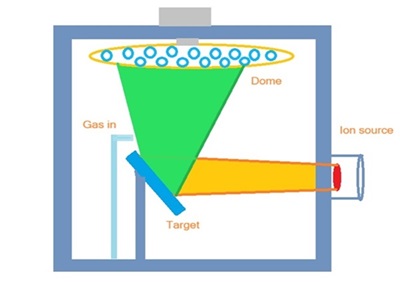
Principle of Ion Beam Sputtering (IBS) Coating Technology
Products
- Principle of Ion Beam Sputtering (IBS) Coating Technology
- Ion beam sputtering (IBS) coating is a high-end PVD technology characterized by high precision, high density, and low defects. Through a design that completely separates the ion source from the target material, it achieves independent and precise control of deposition parameters, making it currently a high-end coating technology for film quality and uniformity.
- Core Advantages of Ion Beam Sputtering Coating
- 1. High densification and low defects.
- 2. Interface combination enhancement: Ion beams can simultaneously assist in substrate cleaning and interface mixing, improving adhesion.
- 3. Precise control of composition and thickness: ion energy, beam current, and incidence angle are independently adjustable; film thickness uniformity is <±0.5%, refractive index error is <±0.1%, suitable for multi-layer precision film systems.
- Ion Beam Sputtering Coating Technology Route and Equipment Composition
- 1. Standard Single-Beam IBS (General) Configuration: 1 main ion source (for target bombardment), high vacuum chamber, target/substrate fixture, optical film thickness monitoring. Features: simple structure, high stability, moderate cost; suitable for mid-to-high-end optical filters, antireflection coatings, and laser coatings. Typical applications: laser gyroscopes, spectrometers, high-end camera lenses.
- 2. Dual-beam IBS (IBS IAD composite) configuration: 1 main ion source (sputtering target) and 1 auxiliary ion source (directly bombarding the substrate). Features: The auxiliary ion beam (low-energy O⁺/Ar⁺) simultaneously bombards the growing film, further improving density, stoichiometry, and adhesion; the film's laser-induced damage threshold (LIDT) is increased by 50%. Typical applications: high-power laser components, semiconductor photolithography lenses, astronomical telescope coatings.
- The IBS system needs to be designed around the four core modules of 'vacuum environment, target material, ion source, and measurement and control system,' with key components including:
- 1. High vacuum chamber: ultimate vacuum better than 5×10⁻⁵ Pa, reduces film impurities, ensures optical performance.
- 2. Ion source: The mainstream types are radio frequency ICP sources, cold cathode Kaufman sources, and Hall sources, equipped with ion focusing, deflection, and neutralization functions to ensure beam uniformity
- 3. Target material and substrate tooling: water-cooled target holder (to prevent overheating), high-precision rotating/linear moving substrate stage (to ensure uniformity), multiple target position automatic switching mechanism, etc.
- 4. Precision film thickness measurement and control systems: optical ellipsometer, laser interferometer, quartz crystal oscillator, etc.